Fulfilment Germany, UK, European warehousing and fulfilment services. Part of the DK Group.



What does Crowd have to do with fulfilment? Fulfillmentcrowd explains
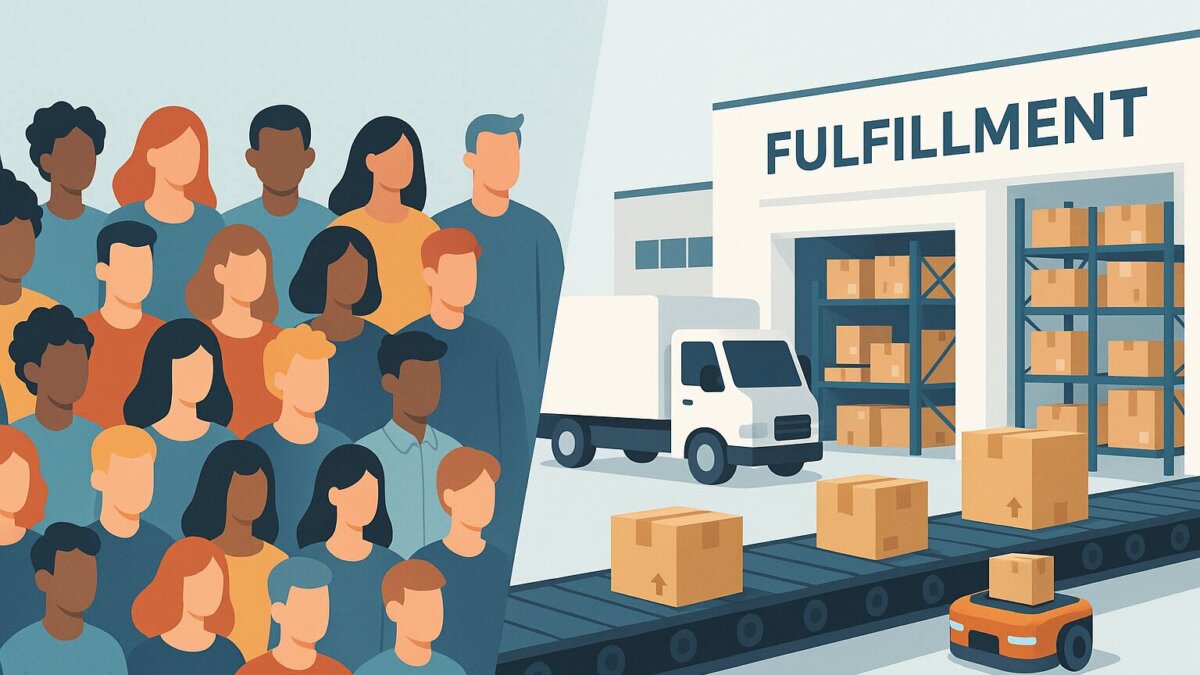
At first glance, the two terms seem to have little in common. While ‘crowd’ refers to a large group of people acting together, fulfilment refers to the professional handling of order processes. In fact, this combination gives rise to an innovative logistics concept that is particularly interesting for online retailers.
The principle of the ‘fulfilmentcrowd’ combines the flexibility of decentralised structures with the need for efficient shipping processing. Instead of relying on large, centralised warehouses, this model uses a network of smaller locations. The spatial distribution enables shorter delivery routes and faster delivery times.
This approach offers interesting prospects for companies looking to optimise their logistics processes. They benefit from scalable solutions that can be adapted to changing needs. The advantage of flexible capacities is particularly evident in the case of seasonal fluctuations. This article explains how the crowd principle is changing the traditional fulfilment industry and what specific advantages this brings.
What does ‘crowd’ mean in a business context?
The term crowd originally describes a large group of people. In the business environment, it has developed into an organisational principle that relies on the collective performance of many participants. Instead of tasks being performed centrally by a single institution, they are distributed among several actors.
Crowdsourcing illustrates this concept particularly clearly: companies outsource specific activities to a large number of external individuals or entities. Each participant takes on a part of the overall task. This structure creates flexibility, as the number of participants can grow or shrink as needed. At the same time, redundancies arise that make the system more stable.
The advantages are obvious: costs can be better controlled because only the capacities that are actually needed are used. In addition, the decentralised organisation enables geographical proximity to customers or markets. Companies no longer have to invest in expensive infrastructure at a single location. Instead, they rely on a distributed network that dynamically adapts to changing requirements. This principle is now being applied in various industries – from software development to logistics.
Fulfillment – A brief explanation of the term
Fulfillment encompasses all processes that take place after a customer’s order is received. This includes the storage of goods, the picking of individual items, packaging and subsequent shipping. Online retailers can take on these tasks themselves or outsource them to specialised service providers.
The complexity of these processes is often underestimated. Each step must be precisely coordinated in order to meet delivery times and avoid errors. Goods receipt, inventory management and returns management are additional components. Many companies reach their organisational limits, especially when order volumes grow.
Traditional fulfilment usually relies on central warehouses with large capacities. These are often located at strategically favourable transport hubs. However, this results in longer transport routes to customers in remote regions. The fixed costs for rent, personnel and technology remain the same, regardless of whether the warehouse is fully utilised or not. Seasonal peaks require additional resources that remain unused outside the peak season. This rigidity makes it difficult for retailers to respond flexibly to market fluctuations and manage costs efficiently.
The intelligent link: ‘Fulfillmentcrowd’
The ‘fulfilmentcrowd’ concept applies the crowd principle to the logistics industry. Instead of a single central warehouse, a network of several smaller storage facilities works together. Each location handles shipping for its region. Goods are distributed to the various points according to geographical demand.
Technically, this system works through intelligent software solutions. They analyse order data in real time and decide which location can execute a delivery most efficiently. Factors such as stock levels, distance to the customer and current capacity utilisation are included in this calculation. The retailer maintains an overview via a central platform, while the physical processing takes place decentrally.
For customers, this means shorter delivery times, as parcels are shipped from the nearest storage facility. Transport distances are significantly reduced, which also has environmental benefits. Retailers gain flexibility: as order volumes increase, the network can be expanded with additional locations. If one warehouse is temporarily out of service, others take over its tasks. This redundancy increases the reliability of the entire system and significantly minimises the risk of delivery bottlenecks.
Advantages of ‘fulfilmentcrowd’ for online retailers
Cost efficiency is a top priority for many retailers. By using several smaller warehouses, there is no need for high investments in large logistics centres. Variable costs are based on actual shipping volumes. Outside of peak times, companies only pay for the capacity they actually need. This structure preserves liquidity and enables more precise financial planning.
Geographical proximity to customers significantly shortens delivery times. Parcels often reach their recipients the next day without the need for expensive express options. Shorter transport routes also reduce shipping costs and CO2 emissions. Customers appreciate this speed, which has a positive effect on customer satisfaction and reviews.
Scalability is another key advantage. During the peak season, the network can be easily expanded without entering into long-term commitments. After the Christmas season or other peak periods, capacity can be reduced again. This adaptability is particularly valuable for growing online shops that want to expand their infrastructure step by step. Retailers thus avoid the typical growing pains of rigid logistics systems and remain competitive with established market players.
Who is ‘Fulfillmentcrowd’ suitable for?
Small and medium-sized e-commerce companies benefit particularly from this model. They can use professional logistics structures without investing in expensive infrastructure themselves. The initial costs are low, and the system grows with the company. Established retailers who want to tap into new markets will also find a flexible solution here.
Certain product categories are particularly well suited to decentralised storage. Items with high turnover rates and compact dimensions can be optimally distributed across multiple locations. Fashion items, electronic accessories and cosmetic products are typical examples. Heavy or very bulky goods, on the other hand, often require specialised storage capacities that cannot be realised everywhere.
Companies with seasonal fluctuations will find the ‘fulfilmentcrowd’ an ideal answer to their challenges. Garden product retailers need significantly more capacity in spring than in winter. Toy retailers experience their peak business in the fourth quarter. The decentralised system adapts to these rhythms without unused resources incurring costs. Even start-ups with limited budgets gain access to professional logistics and can concentrate on their core business instead of operating their own warehouses.
Conclusion
Combining crowd principles with fulfilment processes creates a forward-looking logistics model. ‘Fulfillmentcrowd’ combines the advantages of decentralised structures with professional shipping processing. Retailers gain flexibility, reduce costs and improve service for their customers at the same time.
Shorter delivery times and more sustainable transport routes are becoming increasingly important for consumers. The decentralised network meets these requirements while dynamically adapting to market changes. This concept offers growing online shops in particular the opportunity to operate professionally without making large investments.
Developments show that rigid logistics systems are becoming less important. Flexible, scalable solutions meet the requirements of modern e-commerce structures. Anyone who wants to optimise their shipping processes should take a closer look at the possibilities offered by “Fulfillmentcrowd”. Find out about specific use cases and assess whether this model fits your corporate strategy. The logistics of the future are distributed, intelligent and adaptable.
Contact us now and get advice