


US to EU Fulfillment for American Brands
Expanding your brand to Europe opens access to over 450 million consumers. With the right fulfillment partner and a warehouse in Germany, US companies can navigate EU regulations, reduce shipping costs, and deliver faster than from overseas.
Request your quote
Tell us your volume — we come back with a tailored setup.

Lufapak operates as the German branch and has been a fulfillment provider since 1998. This ensures optimal coordination between the various work steps and guarantees efficient fulfilment of your orders (order fulfilment). As a network of specialists from Europe and the USA, we offer above-average management and take care of the shipping of your online shop. Logistics can be difficult for small businesses to manage, especially when everything has to run smoothly and efficiently. But even large companies can benefit from our optimised warehousing and shipping processes in e-commerce fulfilment, as it is becoming increasingly difficult to offer good logistics for many shipments.

US to EU Fulfillment – How American Brands Succeed in Europe with Lufapak
US to EU fulfillment has become one of the most important growth strategies for American brands looking to scale internationally. The European single market represents over 450 million consumers with strong purchasing power, and demand for American products continues to rise across categories like fashion, beauty, tech, and specialty goods. Yet many US companies hesitate because cross-border logistics seem complex.
The truth is that expanding to Europe does not have to be overwhelming. With the right fulfillment infrastructure in place, American brands can store inventory locally, comply with EU regulations, and deliver to European customers within one to three business days. This guide covers everything you need to know about entering the European market successfully, from compliance requirements to warehouse strategy and platform selection.
Your personal consultant around Lufapak Fulfillment
You can contact us via Lufapak Germany or directly by telephone on +49 (0) 2631 384-0 or by email sales@lufapak.de

Why Expand to the European Market?
Europe is the second-largest e-commerce market in the world after North America. Countries like Germany, France, the UK, and the Netherlands generate billions in annual online revenue. For US brands that have already saturated their domestic market, Europe offers a logical next step with significant upside.
Consumer behavior in Europe also favors American brands. Products labeled “Made in USA” carry a premium perception in many European countries, particularly in categories like outdoor gear, health supplements, beauty, and fashion. European shoppers increasingly buy from international brands, provided the delivery experience meets local expectations.
Beyond consumer demand, the European market offers diversification. Relying solely on one domestic market creates risk. Brands that sell across multiple regions build resilience against seasonal fluctuations, economic downturns, and supply chain disruptions. A European warehouse also positions your brand closer to emerging markets in the Middle East and Africa, opening additional growth corridors.
European B2C e-commerce keeps growing
+7% in 2024Turnover across Europe rose from €784 billion to €842 billion in 2024, with another 7% of growth projected — and demand for American products is rising with it. The share American brands can still win is the part of the curve that has not been sold yet.
Source: Ecommerce Europe & EuroCommerce, European E-commerce Report 2025 (38 European countries). 2024 turnover €842bn, +7% year on year, +4.6% adjusted for inflation; 7% growth projected for 2025. The 2026 and 2027 figures are forecasts based on the same growth rate.
Common Challenges for US Brands Entering Europe
Despite the opportunity, many American companies face real obstacles when entering the EU. The first and most significant challenge is customs and import regulations. Shipping individual packages from the US to European customers means every order must clear customs, adding unpredictable delays and costs that frustrate buyers.
Taxation is another hurdle. Since July 2021, the EU eliminated the VAT exemption for low-value imports under 22 euros. Every shipment entering the EU now requires VAT collection at the point of sale or import. Without proper registration, US sellers risk packages being held at customs or returned. The Import One-Stop Shop (IOSS) system simplifies VAT for shipments under 150 euros, but it requires registration and ongoing compliance.
Fulfillment speed also creates challenges. European consumers expect delivery within one to three business days. Shipping from a US warehouse typically takes seven to fourteen days, even with express carriers. This delivery gap directly impacts conversion rates, cart abandonment, and customer satisfaction. Brands that warehouse inventory in Europe eliminate this gap entirely and compete on equal footing with local sellers.
Shipping from the US vs. a European Warehouse
Understanding the cost and performance difference between transatlantic shipping and local European fulfillment is critical for any expansion decision. The table below compares both approaches across key metrics.
The financial case is clear. Bulk-shipping inventory to a European warehouse via ocean freight costs a fraction of per-order air shipments. Combined with lower last-mile delivery costs within Europe, brands typically reduce their per-order fulfillment cost by 40 to 60 percent when switching to local warehousing.
Returns management is equally important. European consumers have a legal 14-day return right for online purchases. If your return address is in the US, the cost and inconvenience of returns will deter purchases and generate negative reviews. A local EU warehouse with return processing capabilities solves this problem completely.
Key Industries for US-to-EU Expansion
While nearly any product category can succeed in Europe, certain industries show particularly strong demand for American brands. Understanding which sectors offer the best opportunities helps prioritize your expansion strategy.
Fashion and apparel represent one of the largest cross-border categories. American streetwear, denim, and outdoor brands carry strong recognition in Europe. The EU fashion market generates over 130 billion euros annually online, with Germany, the UK, and France as the top three markets.
Health, beauty, and supplements are experiencing rapid growth. European consumers increasingly seek American beauty brands, particularly clean beauty and wellness products. However, this category requires careful attention to EU cosmetics regulations (EC 1223/2009) and novel food regulations for supplements.
Electronics and tech accessories benefit from global brand recognition. CE marking is mandatory, and WEEE registration (Waste Electrical and Electronic Equipment) is required in most EU countries. Despite the regulatory overhead, margins in consumer electronics remain attractive for cross-border sellers.
Outdoor, sports, and lifestyle products from US brands enjoy cult status in Europe. From camping gear to fitness equipment, American brands are perceived as innovative and high quality. This perception translates into willingness to pay premium prices, offsetting the additional logistics costs.
Home, kitchen, and interior goods travel well across the single market. American design and houseware brands are increasingly discovered on European marketplaces, and bulky items in particular benefit from local stock: last-mile distances stay short and returns never cross the Atlantic.
Pet supplies and specialty food are repeat-purchase categories with strong subscription potential in Europe. Reorder models depend on short, predictable delivery times, which makes local inventory a requirement rather than an option — with EU labelling and food regulations clarified before launch.

EU Compliance and Regulations for US Sellers
Compliance is the area where most US brands need the most guidance. The European Union enforces strict product safety, labeling, and environmental regulations that differ significantly from US standards. Understanding these requirements before entering the market prevents costly mistakes.
VAT and IOSS remain the starting point. US sellers must either register for VAT in each EU country where they store inventory or use the IOSS mechanism for direct shipments under 150 euros. For brands using a European warehouse, VAT registration in the warehouse country is mandatory. Germany, as Europe’s largest economy, is the most common choice for initial registration.
Product compliance covers CE marking for electronics, toys, machinery, and personal protective equipment. REACH regulations govern chemicals in products sold in the EU. The General Product Safety Regulation (GPSR), effective since December 2024, requires every product sold in the EU to have an EU-based responsible person listed on the product or packaging. Extended Producer Responsibility (EPR) requires sellers to register for packaging waste recycling in each market.

Logistics and Fulfillment Infrastructure in Europe
Building the right logistics infrastructure is what separates successful EU expansions from failed ones. US brands essentially have three fulfillment models to choose from, each with different trade-offs in cost, complexity, and speed.
Third-party logistics (3PL) is the most popular model for US brands entering Europe. A 3PL provider stores your inventory, picks and packs orders, and handles shipping and returns on your behalf. This model eliminates the need for your own warehouse, staff, and carrier contracts in Europe. The right 3PL partner also handles customs clearance for inbound bulk shipments and integrates with your existing e-commerce platforms.
Amazon FBA Pan-European offers another route, particularly for brands already selling on Amazon US. While FBA provides access to Amazon’s logistics network, it comes with limitations. You lose control over packaging, branding, and the unboxing experience. FBA fees have increased significantly in recent years, and inventory storage limits can restrict your product range.
Hybrid models combine 3PL and marketplace fulfillment. Many brands use a 3PL warehouse as their European hub, fulfilling direct website orders and preparing pre-FBA shipments for Amazon simultaneously. This approach provides maximum flexibility and reduces dependency on a single sales channel.
Selling on European E-Commerce Platforms
Europe’s e-commerce landscape differs fundamentally from the US. While Amazon dominates in the United States, the European market is far more fragmented. Understanding the platform landscape in each country is essential for maximizing reach and revenue.
Amazon Europe remains the largest single platform, with strong marketplaces in Germany (amazon.de), France (amazon.fr), Italy (amazon.it), Spain (amazon.es), the Netherlands (amazon.nl), and the UK (amazon.co.uk). However, Amazon’s market share varies dramatically by country. In Germany, Amazon captures roughly 50 percent of online retail. In France, the figure drops below 25 percent.
Regional platforms hold significant market share in many countries. Zalando dominates fashion in Germany and is expanding across Europe. Bol.com is the leading marketplace in the Netherlands and Belgium. Cdiscount holds a strong position in France. Allegro dominates Poland. Ignoring these platforms means leaving substantial revenue on the table.
Your own webshop remains important for brand building and margin protection. Shopify, WooCommerce, and other platforms allow you to sell directly to European consumers. Payment methods vary by country. Dutch consumers prefer iDEAL, Germans favor PayPal and Klarna, and French shoppers often use Carte Bancaire. A European fulfillment partner can integrate with all major shop systems to ensure seamless order processing.
The Post-Brexit Factor: Why You Need Germany and the UK
Brexit fundamentally changed the logistics landscape for selling in Europe. The United Kingdom left the EU single market and customs union on January 1, 2021. This means that selling into both the EU and the UK now requires two separate fulfillment strategies, two sets of compliance registrations, and two inventory pools.
For US brands, this creates an important strategic decision. Shipping from a single EU warehouse to UK customers now involves customs declarations, potential delays, and additional duties. The same applies in reverse. A single UK warehouse cannot efficiently serve EU customers without customs friction.
The most effective solution is a dual-warehouse strategy with locations in both Germany and the UK. Germany serves as the gateway to the entire EU single market with its 27 member states. The UK, despite Brexit, remains Europe’s third-largest e-commerce market with over 60 million consumers and strong affinity for American brands.
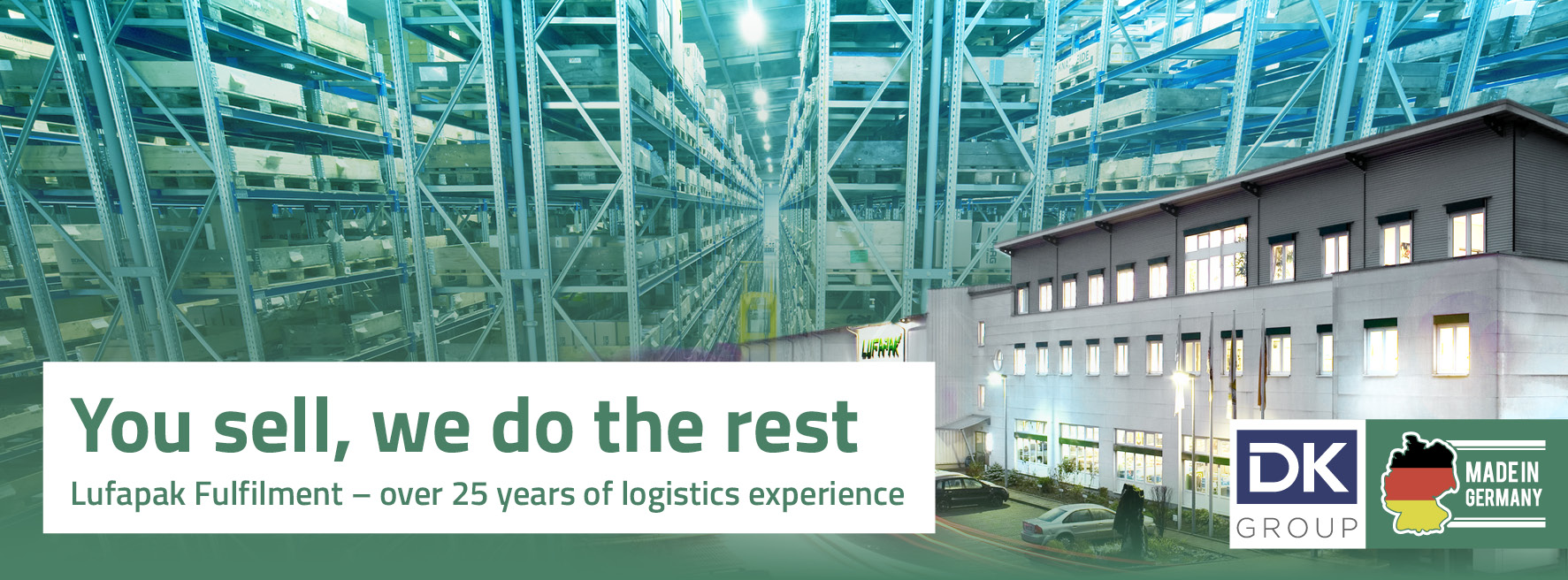
At Lufapak, we offer exactly this dual-warehouse capability. Our facility in Neuwied, Germany, handles EU-wide fulfillment and international shipping, while our UK site in the West Midlands manages UK fulfillment for British orders. Both facilities operate under the DK Group umbrella, ensuring unified processes, shared IT systems, and consolidated reporting for your brand.
Germany as Your European Fulfillment Hub
Germany is not just Europe’s largest economy. It is also the continent’s most strategic location for fulfillment operations. Several factors make Germany the ideal choice for US brands establishing their first European warehouse.
Geographic centrality means fast delivery across the continent. From a warehouse in central-western Germany, ground shipping reaches France, the Benelux countries, Austria, Switzerland, Denmark, and Poland within one to two days. Southern Europe and Scandinavia are reachable within two to three days. No other European country offers this level of geographic coverage.
Infrastructure quality in Germany is world-class. The country has Europe’s densest highway network, major international airports in Frankfurt, Cologne, and Düsseldorf, and the largest inland port network. Carrier options include DHL, DPD, GLS, Hermes, and UPS, all operating at competitive rates due to the high package volume in the German market.
Market size adds another advantage. Germany alone generates over 90 billion euros in annual e-commerce revenue. Warehousing in Germany means your inventory is already positioned in Europe’s largest single market. Combined with the e-commerce fulfillment capabilities of a German 3PL, your brand can serve the entire EU from one location.
With over 25 years of fulfillment experience, ISO 9001 and ISO 14001 certifications, and more than 20,000 square meters of warehouse space, Lufapak provides the infrastructure US brands need. Our in-house IT team connects your shop systems via API, EDI, or CSV, ensuring real-time inventory visibility and automated order processing from day one.


Getting Started with EU Fulfillment
Expanding to Europe is a significant step, but the process becomes manageable when broken into clear phases. The following roadmap outlines the key steps for US brands preparing their European launch.
Phase 1 – Market Assessment and Compliance
- Identify target markets (start with 2–3 countries)
- Research product-specific regulations (CE, REACH, GPSR, EPR)
- Register for VAT in your warehouse country
- Appoint an EU Authorized Representative if required
Phase 2 – Fulfillment Partner Selection
- Evaluate 3PL providers based on location, capabilities, and IT integration
- Confirm carrier network and delivery speed commitments
- Review return handling processes and costs
- Check scalability for peak seasons and growth
Phase 3 – Inventory and Integration
- Ship initial inventory via ocean freight to European warehouse
- Connect your e-commerce platforms (Shopify, WooCommerce, Amazon)
- Set up real-time inventory tracking and order automation
- Test the full order cycle from purchase to delivery to return
Phase 4 – Launch and Optimize
- Start with a soft launch in one to two markets
- Monitor delivery performance, return rates, and customer feedback
- Scale to additional markets and platforms based on data
- Optimize inventory levels and reorder cycles
The most common mistake US brands make is trying to manage European fulfillment remotely without a local partner. Time zone differences, language barriers, and regulatory complexity make this approach unsustainable. Working with an experienced fulfillment partner who understands both US business practices and European market requirements dramatically accelerates your time to market.
Ready to explore your options? Get in touch with our team to discuss your European expansion. We evaluate your product range, order volumes, and target markets to build a tailored logistics solution for your brand.
Get in touch with our team
Tell us your volume – we build the setup
We evaluate your product range, order volumes, and target markets to build a tailored logistics solution for your brand.